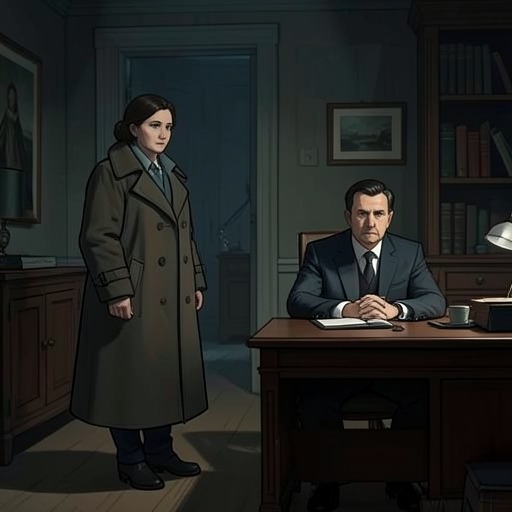
Hokitika Magistrate’s Court
The LuminariesHokitika Magistrate’s Court is the town’s principal visible instrument of civil justice: a place for claims, mining disputes, and criminal proceedings, and a point of contact between official procedure and the unsettled customs of a gold-rush community. Its work appears in modest details—a court bulletin in a newspaper, a clerk collecting bail, crowded lists of claims—but those details show how legal authority reaches into daily life. The court’s presence does not settle the frontier’s competing ideas of justice. Instead, it stands at the center of a town where formal law, diggers’ expectations, and unequal social power continually rub against one another.
Public Presence and Everyday Business
The court enters the narrative first as public information. Walter Moody recognizes Aubert Gascoigne from an address published in the West Coast Times, where Gascoigne had offered an opinion on behalf of the court. The paper’s courthouse bulletin listed that month’s arrests before Gascoigne’s short address, placing the court’s official voice beside a record of local crime. For a newcomer, the bulletin offers a compact map of the town’s legal world: those arrested on one side, those who enforce the law on the other. Moody happens to notice Gascoigne’s name through an association with his former Latin master, but the encounter draws him into a conversation about a case that has become a public concern.
The court’s importance is also measured by the traffic it attracts. On a typical Saturday, as diggers return to Hokitika and the population swells to roughly four thousand, its clerks are overrun with petty claims and mining rights. The work belongs to a larger rush of transactions: brokers handle pledges, merchants serve prosperous customers, and poorer residents petition for credit. The court is therefore not remote from the town’s economic life. Claims to land and mining rights pass through its offices alongside the disputes and debts generated by the gold economy.
Its records later become useful for another purpose. While pursuing connections among George Shepard, Alistair Lauderback, and Crosbie Wells, Gascoigne searches courthouse archives relating to Shepard’s appointment, the temporary Police Camp, and the proposed gaol. The court appears here not only as a forum for present disputes but as an administrative record of how authority has been assembled in Hokitika. Its files may help reconstruct relationships that public appearances and private dealings have obscured.
Procedure in Anna Wetherell’s Case
Anna Wetherell’s prosecution shows how court procedure connects the gaol to the town’s formal justice system. She has been committed on a charge arising from an attempt to take her own life. Aubert Gascoigne describes the case to Walter Moody as an arresting symmetry: Anna is being tried for trying. His response underscores both the peculiar shape of the charge and the public attention surrounding it; the court’s proceedings have become a subject of conversation beyond the courthouse itself.
The practical steps of her release begin at the gaol-house. At the end of the day, the justice’s clerk arrives to collect bail from detainees able to raise the required amount. Anna summons him, produces coins concealed in her corset, and pays them one by one into his hand. The bail is recorded as met, obliging Governor Shepard to release her, and he does so promptly. The scene makes procedure tangible: the money must be produced, the payment entered, and the gaoler’s authority gives way once the condition is fulfilled. It also shows how precarious access to that procedure can be, since release depends on Anna’s ability to find the sum herself.
At the Magistrate’s Court the following day, Anna declines to plead and pays the fine imposed on her without argument. Her case thus moves from committal to bail and then to a hearing and penalty, without any indication that the proceedings repair the circumstances that led to her detention. Gascoigne’s earlier account makes the prosecution a public spectacle of legal language; the clerk’s visit and Anna’s payment reveal its material consequences. The court can process her case, but the narrative does not present that process as equivalent to care or protection.
Civil Law and Digger Justice
George Shepard’s reflections set the court within a broader contest between formal law and the goldfields’ informal code. He describes a community in which a man may seek the Magistrate’s Court’s authority against a woman, resent being refused, and then take the dispute into his own hands. In Shepard’s account, the resulting violence is intensified by the offender’s belief that his own sense of digger’s rights has been affronted. The issue is not simply that two systems of justice coexist; it is that people may invoke one system when it serves them and reject its limits when it does not.
Shepard rejects digger’s law as base, yet his account also exposes the limits of civil authority. He warns that a man’s fellows may rally around him in defense of digger’s rights, making collective anger harder to contain than an individual quarrel. The court’s authority therefore depends on more than its formal procedures: it operates in a society where a crowd may recognize a different code and where those with local standing can claim its protection. The transition to civil law is neither complete nor neutral. Shepard’s insistence on civilization coexists with a rigid judgment of Anna, whose profession and suffering leave him with little sympathy. His account reveals how official order can condemn frontier violence while still reproducing severe moral distinctions between those it considers worthy of protection and those it does not.
Authority, Access, and the Frontier
The court’s formal procedures sit within a wider hierarchy of access to law. Ah Quee describes being struck, insulted, and threatened by Dick Mannering without consequence, and argues that people in Hokitika will favor Mannering because he is not Chinese. His statement does not describe a specific judgment by the court, but it places legal institutions within a community where Chinese residents cannot expect equal support. The court’s presence, then, should not be mistaken for an assurance that all inhabitants can rely on the same protections.
Across these episodes, Hokitika Magistrate’s Court embodies both the promise and the incompleteness of civil order. Its lists register claims and mining rights; its clerk administers bail; its hearings impose penalties; and its archives preserve the paperwork of local government. Yet the novel places these functions beside informal coercion, social prejudice, and Shepard’s own limited empathy. The court can make authority legible and enforceable, but it cannot by itself reconcile the competing codes—or erase the unequal conditions—of the frontier.